
Gallery Wall Spacing Calculator
Use this free gallery wall spacing calculator to get exact nail positions for a perfect gallery wall. No math needed.
Gallery Wall Spacing Calculator
Enter your wall and frame sizes. Get exact nail spots.
Hang pictures so their center is 57 inches from the floor, and leave 2 to 3 inches between frames. Above a sofa, leave 8 to 10 inches between the furniture and the bottom of the art.
How Far Apart Should Pictures Be on a Gallery Wall?
Most gallery walls look best with 2 to 3 inches of space between frames. This gap is wide enough to let each piece breathe. It is tight enough that the group still reads as one display.
Small frames do well with a 2-inch gap. Large frames often need 3 inches. If your frames are wider than 20 inches, try 3 to 4 inches. The bigger the art, the more air it needs around it.
Keep every gap the same. Uneven gaps are the fastest way to make a wall look messy. Measure each gap with a ruler or a small spacer block. A piece of cardboard cut to 2 or 3 inches works great.
The gap you pick also changes the total size of your display. Three 16-inch frames with 3-inch gaps span 54 inches wide. The same frames with 2-inch gaps span only 52 inches. Use the calculator above to see your exact total before you pick up a hammer.
The 57-Inch Rule: How High to Hang Pictures
Museums hang art so the center sits 57 inches from the floor. This is called the 57-inch rule. It puts art at eye level for most adults. Your gallery wall will feel natural at this height.
To use it, find the center of your whole arrangement, not each frame. Add up the full height of your grid, then divide by two. Place that midpoint at 57 inches. The calculator does this math for you.
For a single row of 20-inch-tall frames, the total height is 20 inches. Half of that is 10 inches. So the top edge lands at 67 inches from the floor. Each nail then sits 2 inches below the top of its frame, at 65 inches.
This rule works on any open wall. Hallways, entryways, and dining rooms all follow it. When in doubt, hang a touch lower rather than higher. Art hung too high is the most common mistake in home decorating.
Hanging Art Above a Sofa, Bed or Console
When art hangs above furniture, forget the 57-inch rule. The furniture sets the height instead. Leave 8 to 10 inches between the top of the furniture and the bottom of your frames.
Start by measuring your furniture height. A standard sofa is about 33 inches tall. Add 8 inches of breathing room. That puts the bottom edge of your art at 41 inches from the floor.
With 20-inch-tall frames, the top edge lands at 61 inches. Each nail goes 2 inches below the top of its frame, which is 59 inches from the floor. The calculator above gives you these numbers the moment you pick “Above furniture.”
Width matters too. Your art should span about 2/3 the width of the furniture below it. A 54-inch-wide gallery looks right above an 84-inch sofa. Art that is too small gets lost. Art that is too wide feels top-heavy.
Working with a tight space? See our small home office ideas for wall styling that works in small rooms.
How Big Should Art Be Above a Sofa?
A simple rule keeps the balance right: your art or gallery wall should span about two-thirds the width of the sofa. That leaves a nice strip of empty wall on each side. Use this chart to pick a total art width that fits your sofa.
Art width guide: your art should span about two-thirds of your sofa width.
| Sofa width | Ideal art width (2/3) | Space on each side |
|---|---|---|
| 72 inches | 48 inches | 12 inches |
| 78 inches | 52 inches | 13 inches |
| 84 inches Most popular | 56 inches | 14 inches |
| 90 inches | 60 inches | 15 inches |
| 96 inches | 64 inches | 16 inches |
Your sofa falls between two sizes? Round the art width to the nearest whole inch. If your wall is wide enough, aim for the larger option. The calculator above can also fine-tune nail positions for any layout.
Gallery Wall Spacing Chart
Use this quick chart when you want a starting point. Then fine-tune with the calculator.
Gap sizes at a glance: pick a gap that matches your frame size and style.
| Gap size | Best for | Typical frames |
|---|---|---|
| 2 inches | Tight, modern grids | Frames under 14 inches wide |
| 3 inches Most popular | Most gallery walls | Frames 14 to 24 inches wide |
| 4 inches | Large statement pieces | Frames over 24 inches wide |
Two inches is the most popular choice for matching frame sets. Three inches suits mixed art with breathing room. Four inches is for oversized pieces that need to stand apart.
How to Use This Calculator
Start by picking inches or centimeters. Then measure your wall from edge to edge and type in the width.
Next, tell the tool how many frames go across and how many go down. A 3 by 1 grid means three frames in a single row. A 2 by 2 grid means four frames in a square.
Enter your frame width and height. Measure the outside edges of one frame. Pick your gap size with the buttons. Most people choose 2 or 3 inches.
The hanger drop is the distance from the tight wire to the top of the frame. Pull the wire up like it sits on a nail, then measure. Two inches is typical.
Last, pick where it hangs. Choose “Open wall” for a hallway or empty wall. Choose “Above furniture” and enter the furniture height for art over a sofa or console. Your nail positions appear right away, with a preview drawing.
How We Calculate It
The math is simple once you see it. Here is what the tool does with your numbers.
First it finds the total width: frames across times frame width, plus the gaps between them. Three 16-inch frames with 3-inch gaps give 48 plus 6, or 54 inches. Total height works the same way.
Then it centers the display. It subtracts the total width from the wall width and splits the rest in two. On a 120-inch wall, that leaves 33 inches on each side.
For height, an open wall centers the art at 57 inches. The top edge is 57 plus half the total height. Above furniture, the bottom edge sits 8 inches over the furniture top.
Each nail sits on the center line of its frame, drop inches below the top. Worked example: wall 120, three 16 by 20 frames, 3-inch gaps, 2-inch drop, open wall. Total is 54 by 20 inches. Nails land at 41, 60, and 79 inches from the left, all 65 inches from the floor.
Popular Gallery Wall Layouts
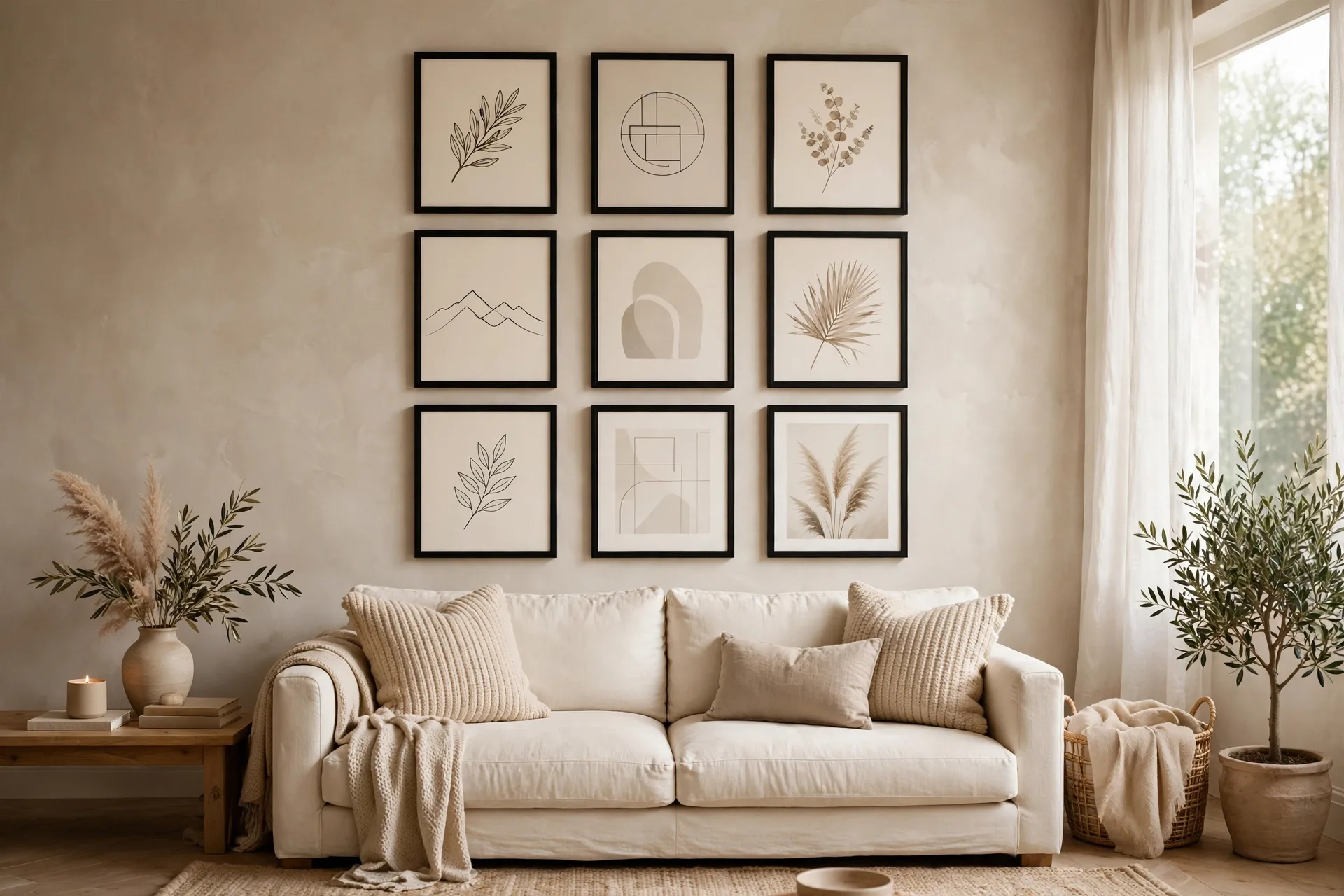
The grid is the easiest layout to get right. Same-size frames, same gaps, straight rows. It suits modern rooms and looks tidy above a sofa or console.
Salon style mixes frame sizes in a loose cluster. Start with the biggest piece in the middle. Build outward, keeping gaps near 2 to 3 inches. It feels collected and artsy.
A single row of frames makes a strong line down a hallway. Line up the centers or the tops, and keep gaps even. Three to five frames is the sweet spot.
Staircase walls follow the slope of the stairs. Keep the bottom of each frame about 8 inches above each step nose. Measure twice here, because the angle tricks your eye.
A ledge wall is another easy option. Picture ledges let you lean frames instead of nailing each one. Overlap frames slightly and vary the heights for a relaxed look. You can swap art in seconds when the seasons change.
Want a breezy coastal feel? Our coastal decor ideas show how light frames and airy art keep a gallery wall feeling fresh.
How to Hang a Gallery Wall Without Extra Holes
Paper templates save your wall. Trace each frame on kraft paper or newspaper. Cut the shapes out and tape them to the wall with painter’s tape.
Mark the nail spot on each paper. Measure down from the top of the frame by your hanger drop. Hammer through the paper, then tear it away. You get one hole per frame, in the right place.
Painter’s tape also makes a great level line. Run a long strip where the tops of the frames will sit. Line up your templates to the tape edge. Step back and check it from across the room before you hammer.
For renters, adhesive strips rated for your frame weight work well. They hold best on smooth, clean walls. Press firmly for 30 seconds and wait an hour before hanging.
Common Mistakes
Hanging too high is mistake number one. If you have to tilt your head up, it is too high. The center of the art belongs near 57 inches on an open wall.
Uneven gaps come next. Eyeballing feels fast but looks sloppy. Use a spacer block or ruler for every gap. Your eye will thank you.
Art that is too small for the wall is another classic. A tiny frame on a huge wall looks lost. Fill about 2/3 of the open wall width, or group small frames into a bigger cluster.
Painting the wall first? Browse our bedroom color ideas for shades that make wall art pop.
Skipping the hanger drop causes crooked results. The nail never sits at the top of the frame. Measure your drop and enter it in the calculator so every nail lands right.
Forgetting wall studs is a hidden mistake. Heavy frames need anchors or a stud, not just a nail in drywall. Anything over 20 pounds deserves a proper anchor. When in doubt, use two hooks rated for the weight.
More Free Home & Garden Tools
Try our other free calculators: the Christmas Tree Lights Calculator, Christmas Tree Size Calculator, Rug Size Calculator, Paint Calculator, and Raised Bed Soil Calculator. Or browse them all on the free home and garden tools page.
Frequently Asked Questions
How high should pictures be hung?
Hang pictures so the center of the art is 57 inches from the floor. This is the museum standard and puts art at eye level for most adults. For a gallery wall, measure to the center of the whole group, not each frame.
How much space between frames on a gallery wall?
Leave 2 to 3 inches between frames. Use 2 inches for small matching frames and 3 inches for larger or mixed pieces. Keep every gap the same across the whole wall.
How high to hang art above a sofa?
Leave 8 to 10 inches between the top of the sofa and the bottom of the art. For a 33-inch sofa, the bottom edge of the frames sits at about 41 inches from the floor. The art should also span about 2/3 the width of the sofa.
How big should art be above a bed?
Art above a bed should span about 2/3 the width of the bed. A queen bed is 60 inches wide, so aim for art about 40 inches wide. Hang it so the bottom edge is 8 to 10 inches above the headboard.
Where do I put the nail if my frame has a wire?
Pull the wire up tight as if it hangs on a nail. Measure from that high point down to the top of the frame. That number is your hanger drop. Enter it in the calculator, and it places each nail that far below the frame top.
How do I hang frames in a straight row?
Run a strip of painter’s tape where the tops of the frames will sit. Mark each nail spot on the tape using the calculator numbers. Hammer on the marks, then peel the tape away.
Can I mix frame sizes in a gallery wall?
Yes. Start with the largest piece near the center and build outward. Keep gaps at 2 to 3 inches and line up at least one edge between neighbors. Paper templates help you test the layout first.
How far should a gallery wall be from the ceiling?
Leave at least 8 to 12 inches between the top of your highest frame and the ceiling. The 57-inch center rule usually takes care of this on standard 8-foot ceilings.